


If you love animals, especially marine animals, you might major in one of the marine sciences when you go to college. Then you might look for a job that would allow you to have contact with animals such as dolphins and whales and study them. Some lucky ones may even find their way to Florida Atlantic University’s Harbor Branch Oceanographic Institute, in particular to its Stranding and Population Assessment team. Six individuals did just that and now make up the current team.
They play an important role at FAU Harbor Branch, responding to dolphin and whale rescues and strandings on our beaches and in our waterways. In addition, they photograph bottlenose dolphins along a 70-mile shoreline and collect and analyze environmental data for research into the quality of water where the dolphins swim.

Team leader Steve Burton admits the hours can be long, and animals in trouble don’t adhere to a regular 9-to-5, Monday-through-Friday schedule. Yet the rewards are great because the work is more than a job. Burton and his fellow marine biologists and researchers on the team do what they love best: they work with the animals.

The team has been in operation since 1998 and is authorized by NOAA’s National Marine Fisheries Service and the Marine Mammal Protection Act of 1972 to take charge of dolphins and whales in distress. Their mandate covers nine species, including bottlenose and spotted dolphins as well as humpback and pilot whales.
Boaters on weekends and holidays are often the first to spot an injured marine mammal and will report it through the Florida Fish and Wildlife Conservation Commission’s Wildlife Alert Hotline at 888-404-3922. This prompts on-call team members to respond to a dolphin wrapped in monofilament fishing line in the Indian River Lagoon or a stranded whale or dolphin on shore.
“Personally, the joy is in protecting the animals and our environment,” Burton says. He grew up surfing in Southern California and always knew he wanted a job that would keep him near the ocean. After college he moved to Hawaii and spent time as a dolphin trainer in the state’s marine parks. From there he went on to work with marine animals in the wild, including their rescue and rehabilitation. Fifteen years ago, he joined FAU Harbor Branch.

While administrative duties curtail some of his work on the water, he is energized seeing the knowledge and experience his younger team members exhibit in their duties. “You need experience to handle a live dolphin so you don’t hurt the animal while trying to help it,” he says.
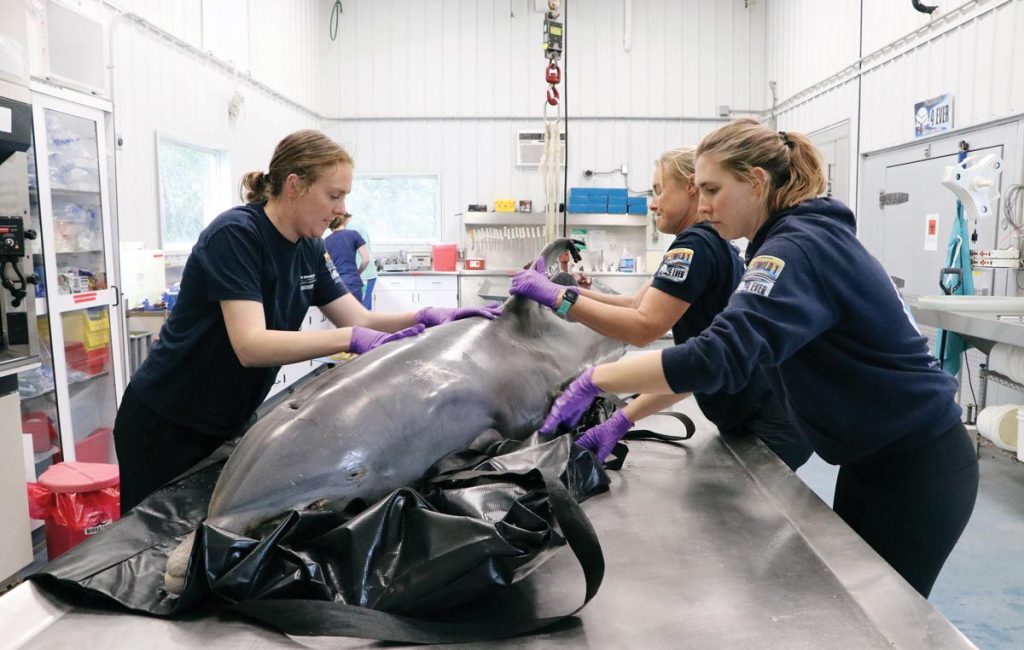
When a dead whale or dolphin washes ashore, it’s the team’s responsibility to transport it to the necropsy lab back at Harbor Branch. If that is not possible, team members will perform the necropsy on the beach.

“We appreciate that all animals are valuable alive or dead,” Burton adds. “When an animal dies, the carcass needs to be studied, which is the job of other scientists at FAU Harbor Branch, like [veterinarian] Dr. Annie Page, who runs the necropsy lab. This way, we gain knowledge of what we are doing to the environment and how we can improve it.”

Data collected in a necropsy help determine the cause of death and support ongoing marine mammal health research. Dolphins, for instance, are a sentinel species for the health of our lagoon ecosystem and its impact on human health.
Unfortunately, there is no simple answer to why stranded animals die. The cause could range from old age to infectious disease, starvation, pollution, trauma, harmful algal blooms, an unusual weather or oceanographic event, or ingestion of marine debris, such as plastic. However, in many cases, even after a necropsy, the cause remains unknown.
If an injured dolphin or whale is a candidate for rehabilitation, the team hands it off to one of its partners. “We get in touch with the stranding coordinator of National Marine Fisheries, who makes that final determination,” Burton explains, “and she contacts one of the rehabilitation centers in Florida to see if it can take the patient.” Three of the most frequently accessed facilities include SeaWorld in Orlando, Clearwater Marine Aquarium, and Gulf World Marine Park in Panama City.

The team transports the animal in its marine mammal ambulance. The rescue vehicle is equipped with a 2-ton stretcher lift, internal water sprayers, an inflatable pool, and other equipment to keep the animal comfortable during the trip.
Rescuing stranded and injured marine species is the more dramatic aspect of the team’s work, but the members actually spend most of their time photographing dolphins and collecting and analyzing behavioral and environmental data for further research. With their fleet of four boats and two Jet Skis, team members zigzag monthly on their survey routes to cover the lagoon in Indian River, St. Lucie, and Martin Counties. They also go 24 miles offshore between the Sebastian and Jupiter Inlets. Through the telephoto lenses on their Canon cameras, they take fin and full-body pictures to record lesions, scars, and entanglements.

The photo identification is also more than a job; it’s personal to the team members. They become so familiar with the dolphins in their surveys that they can recognize the individual animals, and they even give them four-letter names such as Curl, Bird, and Star. They may also identify dolphins they have rescued in the past and are happy to see them back in the swim of things and no longer in trouble. Currently, the team has more than 450 individual bottlenose dolphins in its survey catalogue.
With each dolphin photo, the team records its GPS location, weather conditions, water temperature, salinity, pH level, and amount of dissolved oxygen in the water. These data fuel the research by Brian Lapointe, an FAU Harbor Branch research professor with a PhD in biology, who studies the water quality of our lagoon.
“The water in the Indian River Lagoon has become increasingly impaired over the last several decades,” says Lapointe. “The big debate has been, ‘Where are the sources of pollution coming from?’
“For a number of years the public messaging from environmental groups was that the bulk of nutrient pollution causing harmful algal blooms was coming from farms and residential fertilizers,” Lapointe explains. “But this was not supported by the monitoring data we have collected since 2011. We found that the main source of nitrogen driving harmful algal blooms and seagrass loss in the Indian River Lagoon, especially the northern segments, comes from human waste.”

The main culprit, it turns out, was septic tanks. This discovery has led communities to address the ongoing issue of aging septic systems and the cost of homeowners’ transitioning to sewer systems with advanced treatment that removes nitrogen and other contaminants.
Lapointe acknowledges the important work the team performs in collecting data during its photographic surveys. “Long-term monitoring of the water quality is essential,” he says. “As we clean up septic systems to reduce nutrient pollution, we need to continually compare the data collected today to data collected years ago, to make sure we are achieving positive results with our management actions.”
The health of a dolphin is assessed with each photograph, as well as with each examination performed when an animal is stranded or entangled. This information can further corroborate Lapointe’s water-quality research. “The team’s study of dolphins is imperative,” he says.
“When we study the source of nitrogen in the lagoon, we are working with the very bottom of the food web. Steve’s team is working with the top of the food web with the study of dolphins.”

Lapointe concludes, “The information we get from the health of these sentinel species helps us understand what we call the ‘cascading effects’ of water quality on the food web.” Not that we needed another reason to value the endearing dolphins of the Indian River Lagoon, but this connection further points to their importance, as well as that of the team watching out for them.



 True Tails is a series written by Amy Robinson for Vero Beach’s dog lovers. Ask Amy about your dog’s behavior by clicking below.
Facebook Comments