


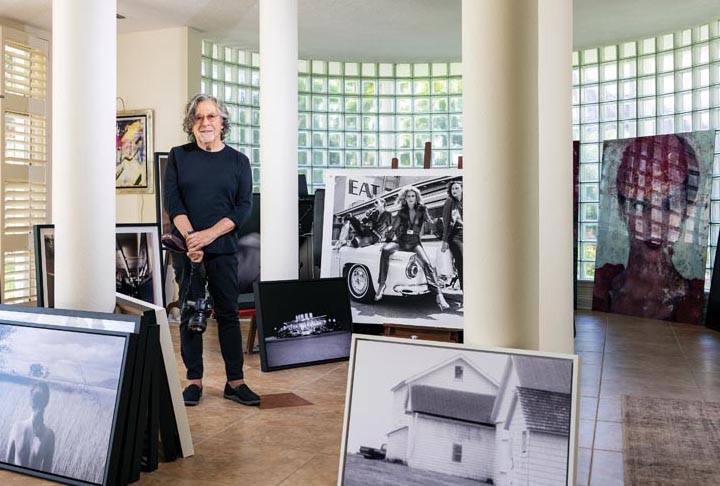
A stroll through the “Timeless” exhibit at the Vero Beach Museum of Art reveals beauty through the artful lens of American photographer Robert Farber. His work has caught the eyes of network TV executives, heads of state, and influential creative directors from the world’s largest advertising agencies when budgets were bursting at the seams. For all his world traveling and far-flung location work, Farber has made Vero Beach his home.

“During COVID, I wanted to get out of New York and decided to spend time in the South of France,” Farber explains. “Some friends who had already moved to Vero Beach suggested I come visit them before I left. They took me around town and I saw immediately how special it was. The art museum impressed me. I thought, ‘Wow, this is a small town but its art museum is not at all small town.’”
He continued on to France, but Vero Beach lingered in his mind. “I never seriously considered another place to live, and I bought a house just from photos online.” Farber and his wife, Judith, have lived in an oak-canopied community on Vero’s barrier island for almost four years.
Farber originally wanted to be a painter. He first picked up a camera to photograph the 1967 Newark riots, a four-day period when unrest and violence took over the streets. While his photos were gripping, he knew he wanted to photograph beautiful things instead. “I would go to these outdoor art shows in New York and display my photos,” he explains. “I really was a frustrated painter, so I would play with concepts and film to create something that looked more painterly, with more of a Renaissance feel.”

He experimented with the tiny Minox spy camera, with its fingernail-size negatives. “When you print those photos and increase the size, it becomes grainy and moody. I also shot transparency film and boosted the speed, then during development I would leave it in the solution longer, which breaks the grain apart to get this painterly effect.” The Selects Gallery in NYC compared one of his softly beautiful nude photos of women at a stream to a Peter Paul Rubens painting.
Early in his career, Farber was setting up at an outdoor art show in Washington Square Park when he was approached by the event’s coordinator. “She asked me, ‘Are these paintings or photographs?’” Farber was pleased; his efforts to elevate photography were working. “I told her they were photographs, and she said I would have to pack up and leave,” he recalls. “The exhibitors on either side of me were showing themed belt buckles and candles. Photography was barely considered an art form back then.”


Luck was on Farber’s side at another art show. One of his favorite images captures Theodore Rousseau’s loft studio in Barbizon, France. Light streams through the window across the well-trodden wood floor. A skylight adds a glow. One can imagine the tiny dust moats floating in the air, reflecting the light and softening the room. A creative director for one of New York’s big ad agencies walked up and studied the photograph. Farber says, “She told me, ‘If you can make that look work with models, I can give you a national ad campaign.’ She was the creative director for Cotton Inc. I said, ‘Sure I can.’ That was what started my career in fashion photography.”
Farber’s fashion work in the 1980s coincided with the first so-called supermodels. Bloomingdales designed ads that crackled with creativity.
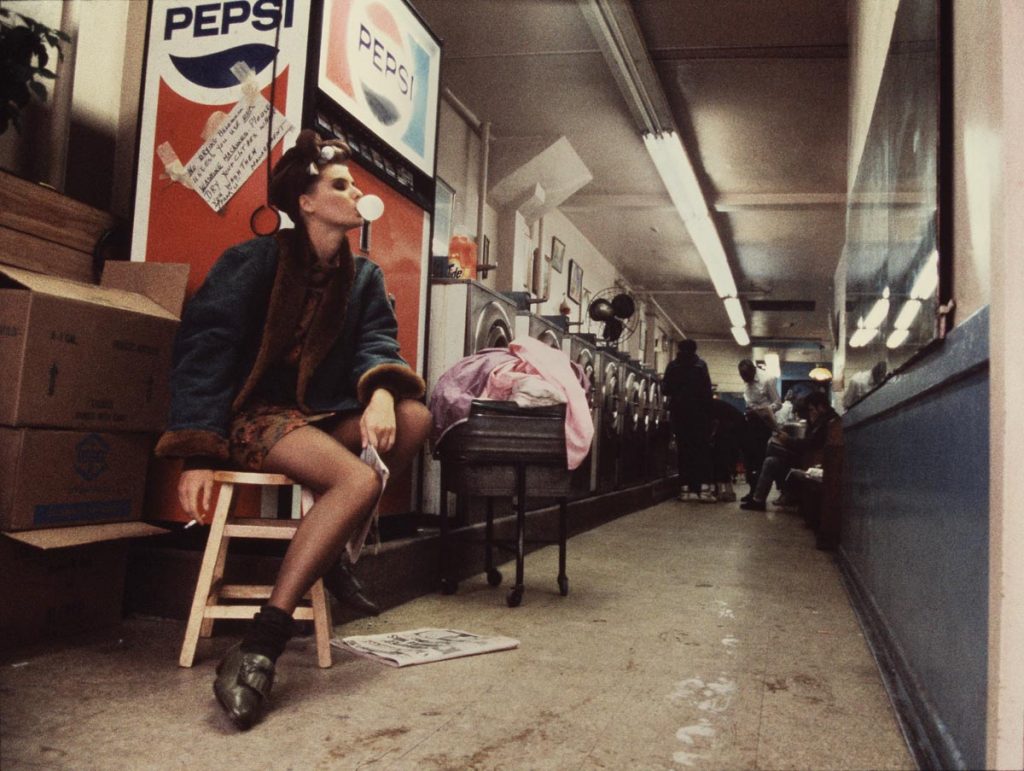
“Bloomingdales wanted slick, impactful images,” Farber notes. “They were doing great work then.” He shot Chris O’Connor, Apollonia van Ravenstein, and Danielle Guerra posing on a vintage car in front of the famously shiny Empire Diner in Chelsea. Janice Dickinson, Debbie Dickinson, and Gia vamp in bathing suits around a lifeguard chair.

Farber photographed Gia for Bloomingdale’s in a white shift dress with his signature soft light. “She was always seen as sexy, but I showed another side of her,” he says. King Charles’ first cousin Catherine Oxenberg and Mick Jagger’s longtime girlfriend Jerry Hall posed for Farber, to name a few.
In the ’90s, he was hired by a German fashion house to show the grittier side of New York. “This was a fun shoot,” Farber says. “We had a model in a pink dress with a full skirt in the meatpacking district. We saw someone walking a bulldog and asked to borrow him.” It started to drizzle, and the wet street and gray sky made the action come alive. “Ads were more creative then,” he notes. “We had to please the client and the creative director, and I always followed their wishes but found time to do the shots my way, too.”
Advertising budgets were much bigger in the 1980s and early ’90s, allowing for more location shooting to achieve the desired effect. “I worked a lot with the ABC Movie of the Week, which was a big deal then,” Farber recalls. “My assistant and I were flown to Africa to shoot stills of Ted Danson and Ally Sheedy for an upcoming movie. The first leg was to London on the Concorde, then another plane to Nairobi and a private plane to the shoot.”
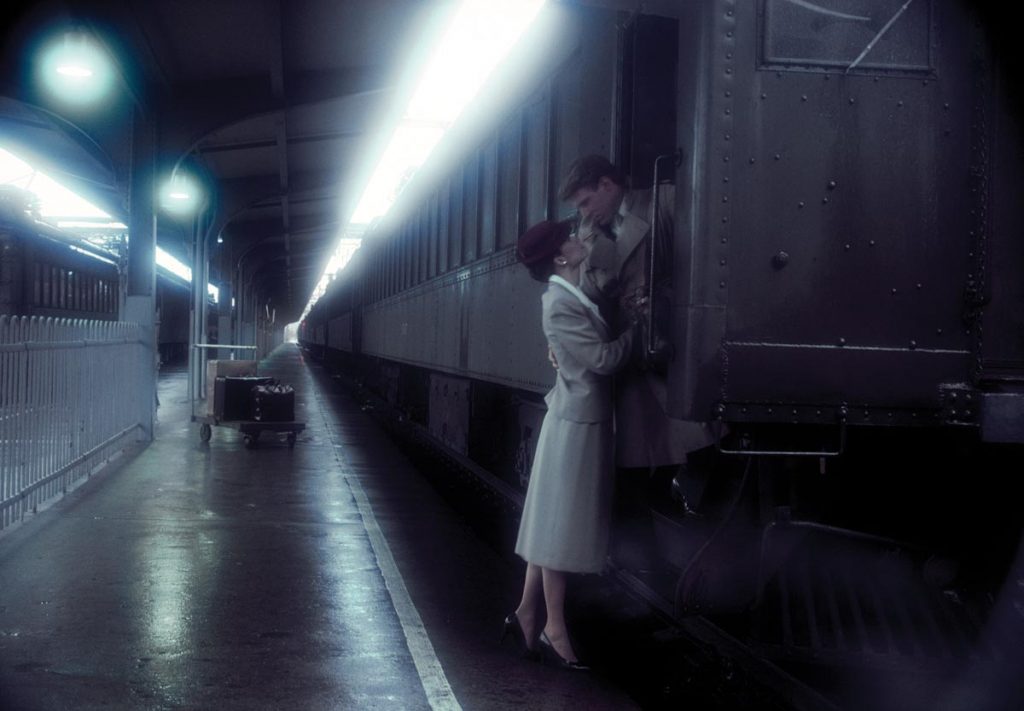
He was flown to Seville, Spain to shoot with Omar Sharif and Ava Gardner for another Movie of the Week. “The weather did not cooperate,” Farber says. “The execs still wanted shots we couldn’t get in Spain, so we all flew back to New York and chartered a plane to Cape Cod and arranged for horses to be there in front of the dunes. These scenes didn’t exist in the movie, so we made them up.”
Later, Capital Cities bought out ABC. As if to underscore the end of a free-spending era, an ABC executive called Farber to tell him that he should pick up that week’s Business Week magazine. “They had published one of my invoices as an example of frivolous spending in advertising.”


While his fashion work gets a lot of attention, Farber is also an accomplished landscape and still life photographer. A crisp photo of a tethered rowboat was noticed by Jacqueline Onassis, who was senior editor at Doubleday publishing. “She wanted to do a book with all photos of beach and shore scenes,” says Farber. “She said to me, ‘Let’s do some photos in the States: New England, Cape May. Can’t you smell the sea air, the lobster cooking?’ We published the book and called it By the Sea.”
Many of his landscapes are unexpected. A gray day on a deserted beach. A massive rock formation amid a restless sea, photographed in black and white. No sunbathers here. “Everything doesn’t have to look like a postcard,” he says. This unique take on what is beautiful helped inspire some of his most famous work, currently on display at the Vero Beach Museum of Art.

The exhibition “Timeless: Robert Farber’s Fashion Photography,” which runs through August 31 in the Stark Gallery, features a one-of-a-kind series decades in the making.
In the early 1990s, Farber was looking at his photos from the late 1970s to the mid-1980s. “These were slides and transparencies in the old plastic, non-archival sleeves,” he explains. “I saw that they had changed, deteriorated, and with that change, new colors appeared, images were altered from the chemical reactions.” Some look as if they have been tie-dyed. Others have large sections of new color that obscure what was originally photographed.

Instead of panicking, Farber was intrigued by time’s contribution to his art. “I continued to watch these works, revisiting them until I thought the deterioration was at its peak.” In 2013, the works were then preserved as is, with no digital retouching of any kind. True to Farber’s experimental tendencies, many of these images are printed on metal using a sublimation technique. “These are dye infused, printed with special inks under very high heat and hundreds of pounds of pressure,” he explains. “This process turns the inks into gases, which are then infused into the aluminum.”

Since the mid-1970s, Farber has published 14 books of nudes, fashion, and landscapes; more are on the way. Italian publisher Graphistudio is compiling his metal-printed works as a limited-edition portfolio presented as a leather-bound book housed in an engraved wooden box that is art in and of itself. This is the anti-digital world of art—a place Farber inhabits with great skill.





 True Tails is a series written by Amy Robinson for Vero Beach’s dog lovers. Ask Amy about your dog’s behavior by clicking below.
Facebook Comments