


When we were kids, we had a croquet set with short mallets that had big, round heads. It came with balls and, of course, the wickets, which were generously sized wire arches we would poke into the ground; they did double duty, keeping the dog out of the flower garden. Our games consisted of trying to whack the opponent’s ball and get ours through the wickets, paying little attention to actual rules or game procedures.
Today, croquet has quietly made its presence known at the most popular private clubs in Vero Beach.
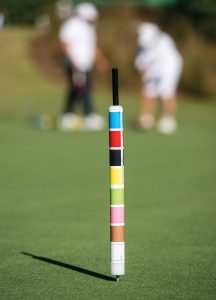
The game is more social than competitive at Windsor, with tennis players and golfers getting to know the pleasures of a low-impact, leisurely day on the court. Frances Mellett drove by the Windsor court daily and wanted to get a group together. “It is a beautiful court,” she says. “I play in Dorset, Vermont in the summer, and we would love to have a lawn of this caliber.”
Mellett gathered some friends and started a Saturday morning game. “All the women that play with me were either avid golfers or tennis players who decided to give croquet a try.” Mellett sees improvement in their skills after a few years of playing together. “Some of the trickier shots, like the jump shot, are still a work in progress,” she says. “The best part is just getting outside and enjoying each other’s company.”
In Vero Beach, the style of croquet called golf croquet is played. This is a simplified version of six-wicket and association croquet. Bo Prillaman is an instructor and the president of the Treasure Coast Florida District of the U.S. Croquet Association. He meets me at the Vero Beach Country Club, his home club, where he has been the teaching pro since 2017.

I am surprised to see the mallets themselves, which have much longer shafts than I remember and a smaller hitting surface, which is square, not round. The second surprise is the narrowness of the wickets. They are taller and straight on both sides, like rungs of a tiny ladder. “There is only an eighth of an inch clearance on either side of the ball,”
Prillaman says. “In tournaments, that goes down to a sixteenth of an inch.”
We watch a game wrap up. Tom Lobsitz comes off the court and sets his mallet down. He has played here for seven years. “I like the challenges of the game. How well you can strike the ball, score, and play offense and defense,” he says. “You’re trying to stay away from your opponent’s ball while putting yours in position to shoot, all in the same stroke.”
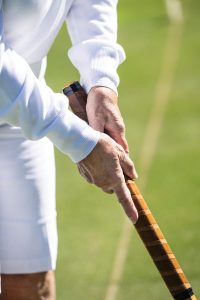


Lobsitz, like all seasoned players, uses strategy to gain an advantage. “I don’t want to set up directly in front of the wicket because many opponents will try to knock you off line. I’d rather my opponent think that I don’t have a shot.” To this end, he practices shooting on angles toward the wicket. “There are some angles that are too extreme, similar to playing pool.”
There are similarities to golf as well. “Check the condition of the grass,” Lobsitz explains, “just like you would look at how the green plays when putting. Dry, windy conditions will make the ground harder, and a dewy morning after a rain will soften it considerably. This all affects ball speed.”

Young players are making a splash in the competitive croquet world, inspiring those growing up in the social media age to take on croquet as a vocation. Most start in college. The world champion is 18 years of age, and many club pros are in their 20s and 30s.
Jack Rush is the croquet pro at John’s Island West. “I came to an event called Wine and Wickets, where the atmosphere is relaxed and people can play and chat while enjoying food and wine,” he says. “I fell in love with croquet then and it has taken over my life.”
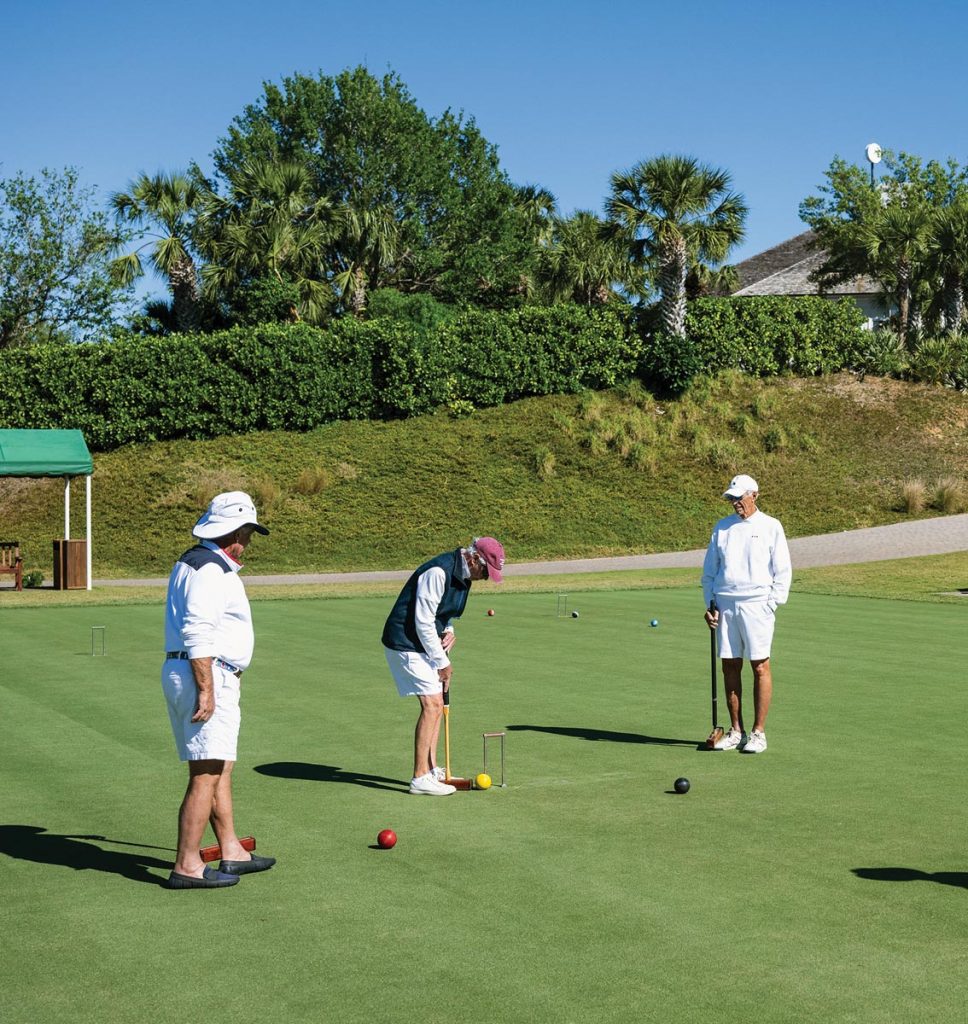
I arrive at the beautiful John’s Island West property and note the two full-size croquet courts. Rush is wrapping up a lesson with Jo Ann Becker, who is a top player at the club. “Don’t forget to stalk first,” he tells her. She backs up to view her line, then approaches, takes a practice swing, which is called casting, and makes an angle shot from a dozen feet back. Stalking is the act of walking up to the ball to plot its path, similar to scoping out a putt.
Dr. Anthony Furino joins us as the lesson is wrapping up and begins a game with Becker. “She’s so good, she makes me look bad,” he jokes. Becker and Furino both hit shots that look impossible, running their balls through the hoops, knocking each other’s balls out of line, and setting up their next shots as advantageously as possible.

“Setting up your shots is 60 percent of the game,” Rush states. “Croquet requires the strategy of chess, the touch of golf, and the angles of pool.”
Furino, a retired orthodontist, took up the game after his wife had a lesson and suggested he try it. “It’s all straight lines,” he grins. “She knew I’d love that.” Furino plays three times a week or more and heads up the travel team that takes on rivals at other clubs. “I’m so addicted that I make my own mallets out of wood,” he says.

Today’s mallet heads are more often made of aluminum, graphite, and even titanium. The square shape allows the mallet to rest without falling over while giving the player more hitting control. Shafts can be wood or metal.
“You start the game either in the yellow flag corner or the red flag corner, then do the four outside hoops followed by the two in the middle,” Rush says. “The winner is the first to make seven hoops.” It sounds simple, but there are choices to be made that will affect all players. “Do I clear, do I set up, do I interfere or block, or just go for the hoop? There are lots of options.”
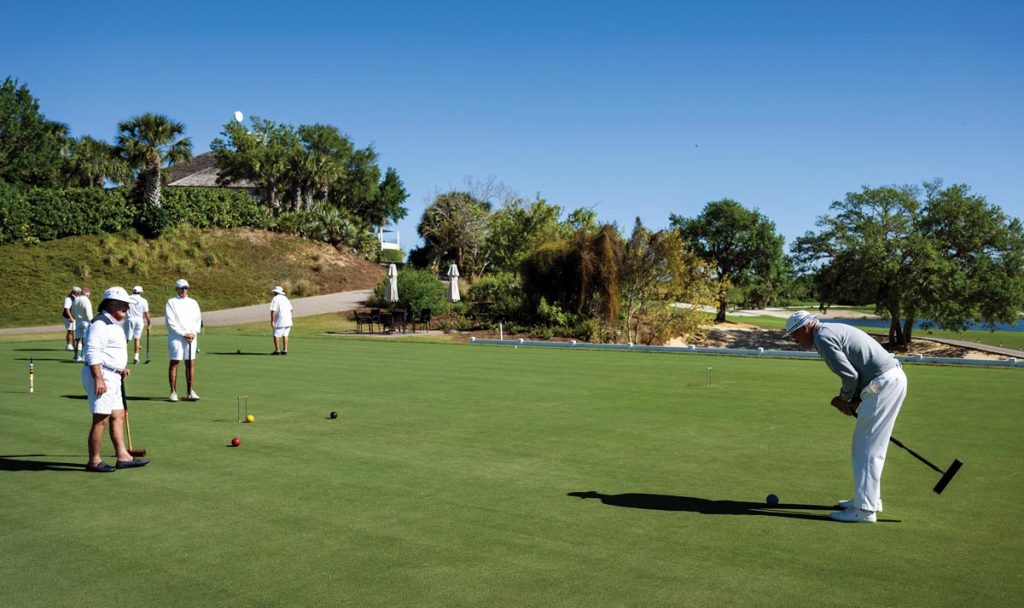
Prillaman is seeking more public access to croquet in Indian River County. “The infrastructure required is low impact compared to building pickleball courts or public swimming pools,” he notes. Last March, he hosted a pop-up croquet day, setting up two courts on the site of the old hospital, which attracted 22 volunteers and a crowd of youngsters and adults. “There are hundreds of underprivileged teens who can benefit from being mentored,” he says. “People of all ages can cooperate and play together, forming valuable community relationships and creating opportunities for these kids they might not otherwise experience.”
Turn of Phrase
Before taking a turn on the court, learn the terms you may hear to better understand the game.
Break: Scoring more than one wicket in a single turn
Casting: A practice swing to establish your line and an appropriate rhythm
Clearing: Hitting an opponent’s ball away from the wicket
Double tap: When the player’s ball is within a few inches of the opponent’s ball and, as the player hits the opponent’s ball, the mallet’s follow-through creates a second hit on the player’s ball. To avoid the disallowed double tap, players may ground their club to eliminate follow-through.
Golf croquet: The simplest form of the game, which is played at clubs in Vero Beach
Hoop: What a wicket is called in Commonwealth countries
Jawsing: Getting a ball snugly stuck into the wicket mouth
Roquet: A stroke in which the striker’s ball hits an opponent’s ball out of line
Stalking: Walking behind the shot to look at the line the ball will travel, then approaching the shot on that line





 True Tails is a series written by Amy Robinson for Vero Beach’s dog lovers. Ask Amy about your dog’s behavior by clicking below.
Facebook Comments