


From the treasures of Egypt to the watchtowers of Han Dynasty China to the artistry of Rembrandt, walking through the John’s Island home of Kim Anderson is a whirlwind tour of history.

A passionate collector, Anderson has loaned artifacts to the Vero Beach Museum of Art for special exhibits. In addition to his current collection, he has bought and sold various works of art over the years, including a number of Picasso sketches. Anderson’s varied artistic finds are complemented by a historic collection of American presidential artifacts, which he also cherishes.
“I’m totally eclectic,” Anderson says. “I get interested in something and then I start collecting it. It’s my way of learning about something.” He chuckles and adds, “If I spend money on it, I’m going to learn about it.”
Anderson’s adventures in collecting began when he was a student at Harvard. He was waiting to meet a date outside the Fogg Museum, and when she was late, he strolled inside to look at a Picasso exhibit. “That was the moment,” he says.
It sparked a fascination with the artist and led Anderson to attend auctions where Picasso sketches were being sold; a sketch, he realized, could be a great investment. With a shrewd eye, he took note of what Picasso’s own art dealers bid for. When everything seemed right, he bid on a sketch himself, and won—paying for it with the next semester’s tuition money. Then, he just had to call his father and tell him.

“He said, ‘You did what? Okay, I’ll send you the money, but don’t ever do it again,’” Anderson recalls, smiling. “My father was very wise, and we had a wonderful relationship. Decades later I gave him a check from the profit I made selling that Picasso.”
Thousands of years separate Picasso from ancient Egypt, but Anderson’s collection is indeed eclectic. During the 1980s, he walked into a gallery in Chicago where modern art was displayed along with an ancient Egyptian artifact. “The impact of that piece in a very contemporary setting really inspired me,” he says. He tried to buy the artifact then and there, but his enthusiasm got the better of him. “The owner heard me making such a fuss about it, and apparently, he decided not to sell. For years, I searched for something that would give me that sense of ancient history with my contemporary collection.”

Eventually, Anderson acquired a gilded mask that once covered the face of an Egyptian mummy, along with the cartonnage—the painted linen garments that were placed over the wrappings of the mummy’s body. Last year, he loaned the artifacts to the VBMA, where they were displayed in an alcove made to look like an Egyptian tomb and served as a highlight of the exhibit “Ancient Egypt and the Napoleonic Era.”

When you look at the artifact, the first thing you notice is likely the golden mask; a close look shows that the gilding has a reddish tinge characteristic of some Egyptian gold artifacts. Surrounding the gold, you see a flamboyant teal color that glitters in the light. Ancient Egyptians obtained this color by grinding gems like malachite into powder and mixing them with their paint.
The artifact evokes the splendor of ancient Egypt; it also serves as a reminder that the foundation of Egypt’s wealth and glory was the Nile River. The paint was applied to a surface made of linen, and the linen itself was made from flax grown along the shores of the Nile. Beyond the reach of irrigation, the land was desert.
The artifact’s richness, along with the time period it dates from, make it likely that the mummy it once covered was a relative of Cleopatra herself. It is from the Ptolemaic Dynasty, a period of Egyptian and Greek fusion following the conquests of Alexander the Great. The dynasty reached its climax with the famous Cleopatra VII, and since the Ptolemaic family tree went straight up and down, a member of the royal family would almost inevitably have been a relative, perhaps an ancestor, of the renowned queen of Egypt.
Treasures of ancient China also form part of Anderson’s collection. There is a Han Dynasty bronze horse, brilliant green in color, with tail upraised and nostrils flaring; an exotic Bactrian camel figure; and a Wei Dynasty ox figure with long horns, a tail like a spearhead, and intricate details such as eyelashes. “I love his face,” says Anderson, looking at the ox.
A Han Dynasty warrior figure Anderson owns still has traces of purple pigment; an artificial coloring made via an ancient yet sophisticated chemical process, it can also be found on figures of the terracotta army at Xi’an.

Another fascinating Chinese artifact, and a favorite of Anderson’s, is a ceramic model of a watchtower. It dates from the Han Dynasty—approximately equivalent in time to the Roman Empire in the West. Astonishingly detailed, it includes figures of archers upon the battlements, while near its base are animal figures: geese, ducks, a turtle, and a dog. The structure of the watchtower provides insight into Han Dynasty fortifications and military architecture, while the animals are curiously endearing; they demonstrate the consistent importance of inspiration from nature in Chinese art.

Circling back from the ancient to the modern, Anderson also values two hanging sculptures, known as “mobiles,” by the American artist Alexander Calder. Anderson explains the enormous appeal such mobiles have for him: “They fill the space with motion, and their design is always changing. They’re whimsical. They dance.” He also recalls the sense of comfort they brought him during challenging times in his life, illustrating how items in a collection can take on new meaning for their owners. Like beauty itself, art is in the eye of the beholder.
That philosophy is reflected in the advice Anderson offers to would-be collectors. “If someone asked me for help, I would take them to a museum and ask them what made them happy.” The subjectivity of art—and the subjectivity of art dealers—is challenging. “How do you separate the wheat from the chaff? You have to buy what you like.” On a practical level, he adds, “And you have to set reasonable boundaries for yourself.”

In the tradition of patrons and collectors throughout history, Anderson has also commissioned new works of art. Michael Coleman is a Western American artist known for landscapes, wildlife images, and scenes evoking traditional Native American life. Anderson commissioned paintings of the Everglades from him—a subject that is truly Floridian yet also in keeping with Coleman’s love of the wilderness.
Anderson also offers this tip for readers building a collection: if an artist you love is known for oil paintings, do not neglect other media. Watercolors, sketches, or prints may be more accessible and offer better value, as he discovered with the Picasso sketch that was his first acquisition. When it comes to prints, Anderson views a great print as an original work of art—printmaking is a medium, he believes, that allows for “multiple originals.” He adds, “You can get great value from prints.”
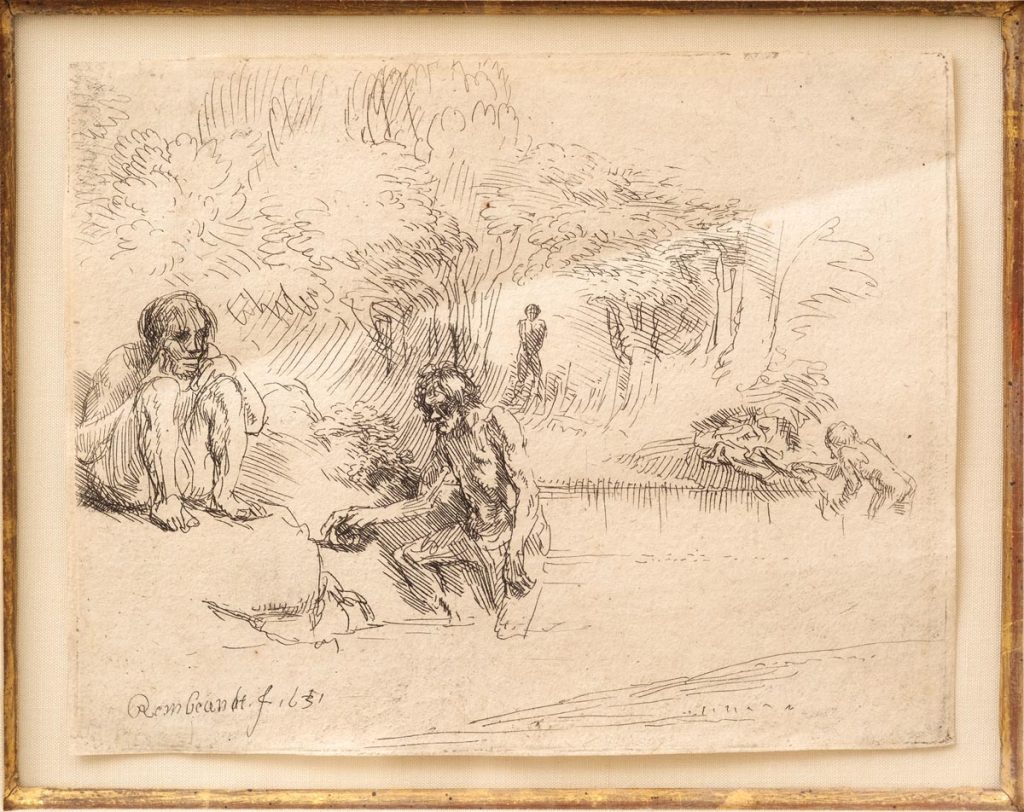
Exemplifying this point are his prints by Rembrandt van Rijn, which he loaned to the VBMA three years ago for the “Vero Collects” exhibition. Rembrandt is truly an “artist’s artist,” inspirational for his perception, skill, and human insight. He made prints from scenes he etched onto copperplates—a painstaking process. The prints are small in size but so intricate that, when displayed at the VBMA, they were accompanied by magnifying glasses so that visitors could more fully appreciate them.
Interestingly, Rembrandt’s paintings are known for their subtle gradations of light, and although the prints are an entirely different medium, the artist’s keen eye for light and shadow is apparent there, too. This fits with Anderson’s advice that if you admire an artist’s oil paintings, you should consider his other art forms as well.

Surveying his own collection with a loving eye and an inquisitive mind, Anderson concludes: “The works or objects that have given me the most enduring pleasure and value were those that I felt I paid a premium for but was convinced that they were the best quality available at the time. There are no bargains when it comes to acquiring the very best. I spent valuable time evaluating quality in a world of subjective valuation. One person’s ‘good’ may be another person’s ‘great.’”
From ancient Egyptian treasures to modern mobile sculptures, from the intricacy of Rembrandt to the flamboyance of Picasso, collecting has been an adventure for Kim Anderson. And the adventure continues.





 True Tails is a series written by Amy Robinson for Vero Beach’s dog lovers. Ask Amy about your dog’s behavior by clicking below.
Facebook Comments