


If walls could talk, the vast collection of original oil paintings hanging throughout the Vero Beach home of Robert Mead Jones and Bonnie Beauchamp Jones would tell the story of a shared journey. Impressionist landscapes, classically rendered portraits, and strikingly realistic still lifes and figurative oils—all painted by the couple—would reminisce about a chance meeting aboard an ocean liner. They would describe studies abroad, a 57-year marriage, world travel, and parallel paths as lawyers and artists. Perhaps most important, they would applaud their creators’ shared passion and talent for recognizing and capturing beauty on canvas.
Like all good journeys, theirs (literally) embarked from New York harbor in 1965. Bob, a 20-year-old student at Yale University, spotted Bonnie, a 20-year-old Denison University coed, on the deck of the ocean liner Queen Elizabeth. Both French majors were preparing to sail to France for their junior year at the Sorbonne. “It was a splendid day in early September, and for me, it was love at first sight,” writes Bob in the couple’s 2021 published book, Art & Beauty: The Paintings of Robert Mead Jones and Bonnie Beauchamp Jones.

Although they were housed with separate families and took different classes, a courtship ensued during their undergraduate studies in Paris. Bonnie immersed herself in an art history course at the Louvre and perfected her French, while Bob, already proficient in the language thanks to a high school year spent in France, studied the German philosopher Georg Hegel.
When the academic year was over, Bob traveled to the northernmost reaches of the world with a friend, while Bonnie remained in Paris, holding several jobs during the long, hot summer. She worked in a small perfume shop behind Notre Dame Cathedral, babysat for a French family, and translated French movie subtitles into English. “It was two or three months before I was really fluent,” she says, “but the experience of discovering art and the beauty of the French language at the age of 20 was pure joy.”

The bond Bonnie and Bob formed during their junior year abroad grew stronger upon their return to the States. Less than three years after their serendipitous meeting, they were married and, like two peas in a pod, pursued parallel paths. Following his graduation from Yale, Bob earned a master’s degree in anthropology from the University of Pennsylvania and a juris doctor from Penn’s Carey Law School. After
graduating from Denison, Bonnie went on to earn a master’s degree in anthropology from Temple University and a juris doctor from Villanova.

In 1972, while pursuing anthropology degrees, the 28-year-old couple returned to France with their 1-year-old son, Derek, in tow. Living in an apartment on the Île Saint-Louis, they continued their graduate studies at the University of Paris. “That was a wonderful year,” says Bonnie, “because not only were we back in France, but Bob was studying comparative law and he was first in his class, which was entirely in French.”
Fluent in both French and Italian, the young couple spent their free time traveling and working as bilingual guides in Paris and the Loire Valley. They may not have known it then, but the seeds of inspiration were already germinating for the art they would later produce.
When they returned to the United States, the Joneses made their home in the Philadelphia suburb of Villanova and made their mark as highly successful lawyers. Bob spent 25 years at one of America’s oldest and largest law firms, where he headed the international corporate practice. Bonnie had a 22-year career as chief counsel and head of the reinsurance law department at Cigna.

While both found joy and inspiration in their careers, they also harbored a nagging urge to paint. Bob’s first artistic foray came in 1978 during a weeklong visit with his parents in Stuart, Florida. He went to an art store, purchased some wooden blocks, sanded them down, and painted a few miniatures. He later returned to the art shop and bought some canvases.

“What began as a lark quickly developed into a talent,” observes Bonnie. “He was growing and experimenting, always in oils, and very early on started to do portraits.” Soon, painting became Bob’s way of relaxing after a day of practicing law. “The amazing thing about him is he could switch gears just like that,” she remarks. “He could pick up a paint brush and be in a whole new world. It got to the point where he’d paint all weekend long, listening to opera.”
Over time, Bonnie says, Bob’s artistic talents were getting better and better. “He was good and then became really, really good. By the 1990s, I started thinking he could do this professionally.” But Bonnie was not content to simply look over Bob’s shoulder and critique. While practicing law, she, too, began producing small works in oil, as Bob had earlier. Though largely self-taught through trial and error, the couple studied the works and painting techniques of artists such as Monet, Renoir, Boldini, and Sargent; and they found time to take courses at the Pennsylvania Academy of the Fine Arts in Philadelphia and the Valdes Art School in Santa Fe.
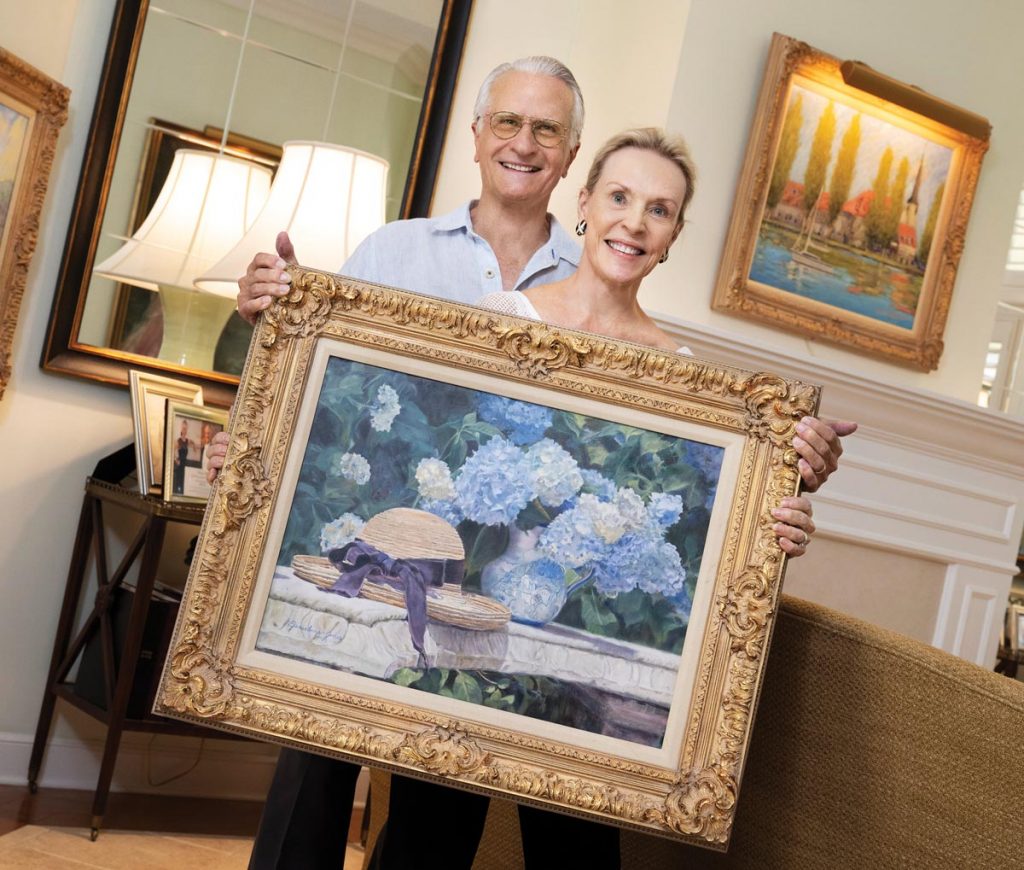
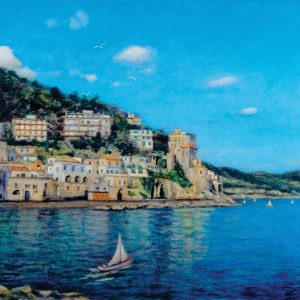
Soon they were both producing oil paintings ranging in artistic style from classic realism to heavy impasto Impressionism and in subject matter encompassing portraiture, landscapes, and still life. All of it, says Bob, “mirrors the breadth of experience in our personal lives. In painting landscapes and still life, our art has but one purpose: to create beauty, nothing more, nothing less. In portraiture, the focal point is the character of the subject.”
While both have their own personal styles and approaches to painting, they have enormous respect for each other’s work. “I’m astonished at how quickly he can get a likeness in portraiture,” says Bonnie of her husband’s talent. “This man is amazing at remembering faces accurately.” Gazing admiringly at one of Bonnie’s highly detailed still lifes, Bob comments, “Bonnie is an ultra-perfectionist. Her paintings are absolutely exquisite.”

By the time the new millennium approached, both were ready for their second acts as artists. “We loved practicing law, but neither Bob nor I wanted to die at our desks as lawyers,” says Bonnie. In 1999, she retired early from her position at Cigna, while Bob retired early from practicing law the following year.
By that time, Bob’s office walls were lined with examples of his oil paintings. During the last week before his retirement, he invited Andy Newman, owner of the Newman Gallery—at the time Philadelphia’s oldest and largest art gallery and the second-oldest in the country—to view his work. Newman was impressed and chose several for his gallery. Later, some of Bonnie’s paintings were added to the mix, and in 2010, the Newman Gallery devoted a two-month exhibition exclusively to 90 paintings by the couple.

Since then, they have been represented by other leading galleries on the East Coast and in Sante Fe. They have garnered numerous awards, including Best in Show in juried art exhibitions. Today, their paintings hang in museums, corporate offices, and private venues throughout the United States, England, France, and Ireland, and their work is sold directly to clients around the world.
Bob’s portrait commissions—now numbering nearly 150—include members of European nobility, a former member of British Parliament, a knight of the British realm, Pennsylvania governor Edward Rendell, Vanguard Funds founder John Bogle, six university presidents, 20 presidents of private clubs (including Quail Valley), federal judges, captains of industry, and many private individuals. That his clients are pleased with their likenesses is evidenced by the astonishing number of repeat commissions he receives—as many as 20 portraits from a single client and nine from another!

The enthusiastic response to his portraits, Bob explains, is due largely to a strategy that departs from a traditional series of sittings in which the subject is a passive participant and the artist is in charge. Bob’s more user-friendly approach puts the person being painted in control of the process. It begins with an initial discussion, followed by a photo shoot, which yields hundreds of images of the subject with various poses, angles, lighting, backgrounds, and perhaps in various outfits. The final decision as to likeness, pose, and composition is made by the subject.

“The primary objective in painting a portrait should be to create a work that reflects the subject’s image of himself or herself in his or her finest hour,” observes Bob. “Some of the people we’ve met through portraiture late in life have become our best friends.”
For Bonnie and Bob, life after law included selling their century-old Villanova home and settling into residences in Vero Beach and La Jolla, California, where they spend five months of the year, to be closer to their son and his family. It has afforded them time to travel and further develop their personal artistic styles. Their shared journey, launched decades ago on an ocean liner, continues its voyage … one brushstroke at a time.





 True Tails is a series written by Amy Robinson for Vero Beach’s dog lovers. Ask Amy about your dog’s behavior by clicking below.
Facebook Comments