


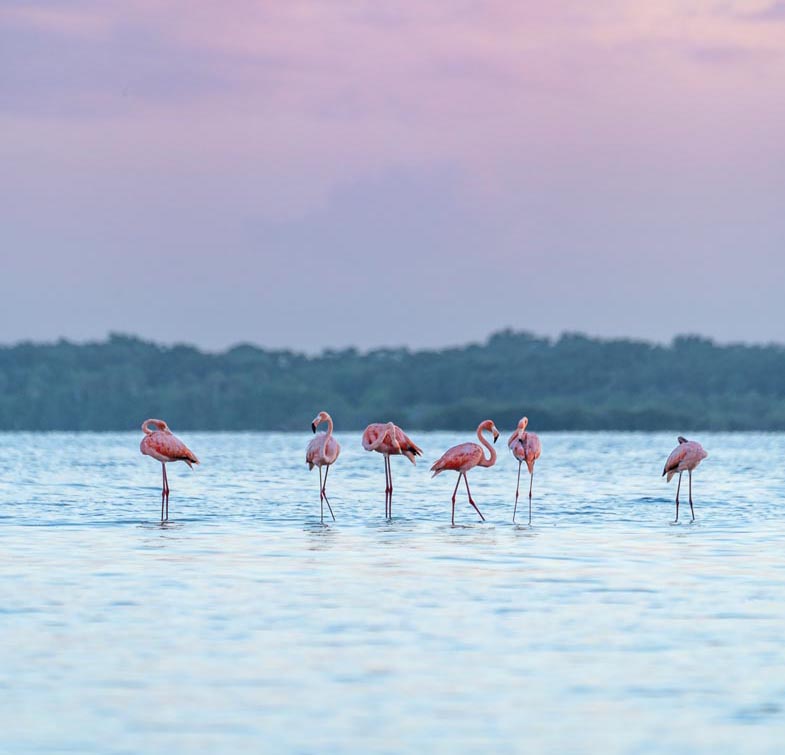
To people all over the country, the flamingo is associated with Florida; yet until recently, a visit to a zoo or an aviary was virtually the only way to see these birds in our state. Nineteenth-century plumage hunting and 20th-century habitat loss had reduced Florida populations to near-mythical status. Now, the colorful flamingo is returning to our shores, as I discovered firsthand during a kayaking trip at Merritt Island National Wildlife Refuge.
I am an avid bird-watcher. In one of my previous articles for Vero Beach Magazine, I wrote about seeing the little auk in far northern waters while traveling aboard the Queen Mary 2, and just a few months before my flamingo adventure I was trekking through the rainforests of Colombia in search of exotic species.
Nevertheless, flamingos are special, attracting the attention of people who might otherwise have little interest in bird-watching. For one thing, their shape is so marvelously bizarre, with their long, curving necks and distinctive bills. And their bold, playful color seems to represent the tropics. It’s fitting that a group of these birds is called a “flamboyance of flamingos.”
These exotic birds fascinated explorers. John James Audubon saw flamingos when he visited the Florida Keys, and the resulting portrait is vibrantly chromatic. Another famous image of the flamingo comes from an earlier, and lesser-known, figure—Mark Catesby, whom I researched while writing Early Nature Artists in Florida. Catesby was an English country squire turned explorer; he may have observed flamingos in Florida or the Bahamas, which he visited during his voyage home. (Flamingos still thrive in the Bahamas, where they are the national bird.)

In his artwork, Catesby portrayed different species together, sometimes based on habitat but sometimes quite randomly; furthermore, he did not concern himself with scale. His image of the flamingo shows the bird standing in front of a piece of coral, and they are about the same size—raising the question of whether it is an enormous piece of coral or a very tiny flamingo. This incongruity may reflect the artist’s sense of whimsy. Another of his works shows a close-up of the flamingo’s bill; he was clearly intrigued by the way the bird uses it to sift through water as it feeds.
These adventurers trekking through the wilderness of 18th- and early-19th-century Florida could not have imagined how bird populations would be devastated by hunting and habitat loss. Avian ecologist Mark Ian Cook, an editor of the South Florida Wading Bird Report, explains, “Wild flamingos were basically wiped out in Florida in the early 1900s.” Since the 1950s, there have been scattered reports of sightings and “a steady increase based on citizen-science reports.” There is also the famous population at Hialeah Park in Miami, but that’s not exactly the wilderness.

Keith Laakkonen, director of the Corkscrew Swamp Sanctuary for Audubon Florida, puts it this way: “Flamingos have always been these iconic birds. Once in a while, there would be a rumor” of sightings in the wild, “but there wouldn’t necessarily be information to back it up.” Then, in 2023, Hurricane Idalia dispersed flamingos to a stunning degree, with sightings in places like Pennsylvania and Wisconsin—Laakkonen calls it “the pink wave.” Of course, that event brought flamingos to Florida, too.
The first time Laakkonen himself saw them in the wild in Florida, he was with a group of fellow bird-watchers, and he recalls his amazement as, “in the midst of all these scopes and binoculars, the flamingos flew in—live and in person!”
While they have not yet been seen at Corkscrew Swamp itself, Laakkonen certainly hopes that will change, given its rich environment marked by centuries-old trees. “I can hopefully see a day when visiting scientists from all over the world can walk outside here and see a flamingo. It would be an amazing thing, and it certainly is not out of the realm of reason.”
In June 2025, Cook had the joy of sighting an impressive flamboyance in the Everglades, more than 120 in all, which he was able to photograph from a helicopter. Does this bode well for the future? At the time of writing (August 2025) there had been no verified reports of nesting or colonies in Florida. Nevertheless, Cook says, “There are places in the Everglades that are wild and remote where they could have nested. When I fly over the Everglades in a helicopter, the flamingos are tough to spot.” Even their vibrant pink plumage can be hidden in the dense greenery deep in the marsh.
He adds, “We have seen instances of flamingos mating in Florida, and that’s a good sign.” Nesting would involve the construction of a chimney-shaped nest of mud and clay; the father and mother work together to keep the eggs warm and provide food for the young.
Flamingos currently seen in Florida may be flying back and forth between here and the Caribbean. “They’re skinny,” Cook says, “but they’re incredibly strong and fast fliers. The fact that they’ve stayed in large numbers indicates there is good food for them to eat. We can hope this is a nucleus, and even if they head back to the Bahamas to breed, their young may follow them back here.”
My own quest to see flamingos in the wild took me to Mullet Head Island, known locally as Bird Island, which lies in the northern reaches of the Indian River Lagoon, just off Merritt Island. As its nickname implies, it has long been known for its varied and significant bird populations. During my trip, I also saw cormorants, hundreds of brown pelicans, a black tern, and great blue herons, including juveniles.

There were also dolphins and manatees in the nearby waters. Exciting though all that would normally be to me, I was focused that day on the flamingos. To find them, I took a kayak excursion with Cocoa Kayaking; my guide, Cricket, was very knowledgeable and enthusiastic. As our group met on the shore and prepared to embark, Cricket pointed out a tiny pink blur on the horizon. The flamingos were there, standing in the water near Bird Island.

Once we were in the kayaks, we paddled toward them until we were 500 feet away—that is the recommended limit to avoid disturbing them. And it was close enough for excellent viewing, especially with my high-powered binoculars. There were seven flamingos there, wading in shallow water. Their pink plumage was as vibrant as I had imagined, and taking the time to observe them closely, I realized there are fascinating variations in the shades of pink.
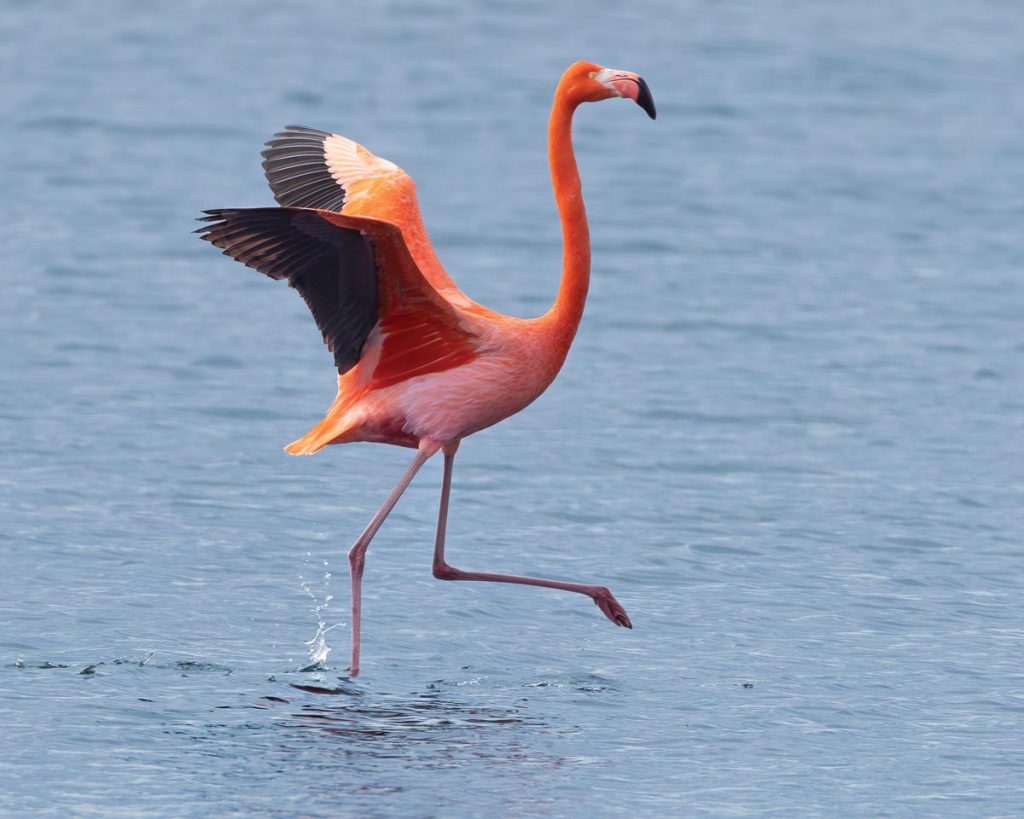
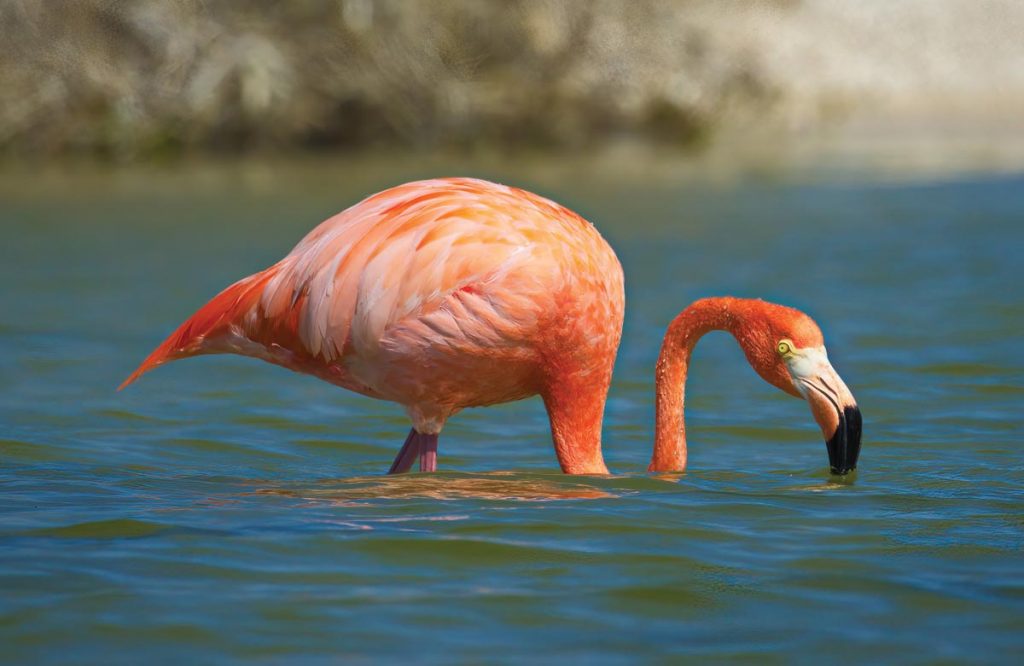
On each bird, some feathers were deeper in hue, nearly scarlet; some were a pale rose; some seemed to blend into white. The color is based upon their diet and also reflects health and breeding status. Flamingos can even enhance it themselves, producing a glandular oil that they rub on their feathers during preening. Brighter plumage is believed to be an advantage in courtship.

As I watched them, one flamingo would at times flap its wings, revealing the black tips of its flight feathers—a striking contrast. For the most part, they were simply standing there, but occasionally one would feed, craning its long neck downward and dipping its bill into the water.
At times they would vocalize, a sound not unlike the gabbling of geese; it echoed across the water as a soft murmur. Two of the flamingos seemed to be looking at each other and interacting, and they were separated slightly from the rest; it is likely they were a mated pair. Eventually, all seven began wading slowly toward the beach on Bird Island. Tall and pink, they stood out dramatically among the pelicans, which nonchalantly ignored them.
These flamingos, like the others sighted in the wild in Florida, represent the species Phoenicopterus ruber, known in the United States as the American flamingo while also being known internationally as the West Indian flamingo or the Caribbean flamingo. The long neck and long legs make them readily distinguishable from roseate spoonbills, our other bright-pink bird.

Seeing flamingos in the wild was a first for me, putting them on my bird-watching “life list.” And it was truly a joy, especially with the beautiful close-up views I was able to obtain thanks to a good kayak and my trusty binoculars.
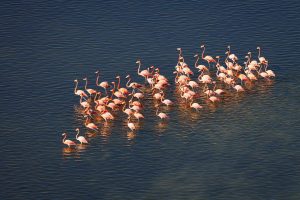
In one of Patrick O’Brian’s Aubrey-Maturin novels (the series that begins with Master and Commander), which interweave natural history with seafaring adventure, there is a scene in which a character with no interest in birds witnesses a flamboyance of flamingos taking wing. It proves to be a kind of conversion experience for him. “If that glorious spectacle is ornithology, then I am an ornithologist,” he declares. “I had no idea that such splendor existed.” Thankfully, it does indeed exist. And now, it has returned to the shores of Florida.





 True Tails is a series written by Amy Robinson for Vero Beach’s dog lovers. Ask Amy about your dog’s behavior by clicking below.
Facebook Comments