


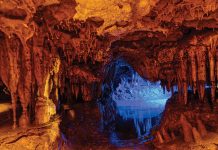
I grew up on the long, sea-lapped sandbar of Florida, where winter freezes brought palls of smoke from smudge pots and old tires burning in the groves. When I attended Coral Gables Elementary School, soon after the rock quarry had been transformed into the Venetian Pool, where you could dive into underground caverns, I learned to draw the state of Florida as an upside-down turkey. During morning assembly, we stood for “Dixie,” played over the school’s loudspeaker.
I have lived through many incarnations of the state, some transformations as seamless as a snake shedding its skin, others as wrenching as unscrewing a rusted nut. I have tried to pinpoint the turning point when the state became New Florida. According to historian James D. Wright, author of A Florida State of Mind, basically everything that existed prior to the opening of Walt Disney World in 1971 is Old Florida. New Florida is everything since, including once-pristine waterways and wetlands paved over, drained, dredged, or made toxic with pollutants.
I have always thought that my pull from Miami to Central Florida’s Vero Beach was born of a yearning to return to Old Florida, still represented in pockets of Indian River County, including fish camps; isolated stands of pine; remnants of abandoned citrus groves that still perfume in the spring; Fellsmere’s Marsh Landing, where you can get fried gator tail that has been soaked in buttermilk; and county offices where everyone is amazingly polite.
I learned to read in a Florida more than a decade past its real estate boom when Binder Boys in knickers hustled lots, sometimes trading promissory notes more than a dozen times in a day, when the FEC was backed up with freight after the Prinz Valdemar sank in Miami Harbor and halted shipping, turning the boom into a bust. Suddenly there were unfinished buildings, signs that swung over empty lots where sandspurs clung to your socks, and roads that led to nowhere, while in the undeveloped piney woods, there were thriving turpentine camps.

My chef father worked alongside a second cook who had worked in a turpentine camp notching trees for resin. The man’s thumbs were extra long, a feature my father said I was never to call attention to.
In the years just before World War II, which would bring the rationing of gasoline and the necessity to put our REO on cinder blocks, my family toured the state in the late spring after the tourist season had ended. With car windows wide open, we rode over the Dixie Highway and the Florida portion of U.S. 1, the longest north-south highway in the country, past convict road gangs in gray-and-white-striped prison garb under the watchful eyes of a guard with a shotgun; roadside zoos, including one behind a gas station where an ostrich pulled a wooden cart; gospel revival tents being erected or taken down; tourist homes with doilies on the backs of sofas that served afternoon sweet tea brewed in the sun; backwoods cockfights, including one near Lake City in a two-story arena with theater seats and, in the ring, two roosters, two handlers, and a referee.
Other than the Dixie Highway, U.S. 1, and the Tamiami Trail, the rest of Florida’s roads were one- or two-lane gravel, shell, or even dirt affairs that usually served to connect one citrus grove with another, often running through marshy swampland. Thirty mph was a breakneck speed as we swerved to avoid the 12-inch tree stumps that road builders were allowed to leave.
Our trips were always in search of something—once to find a certain prehistoric fossil museum in Florida’s Bone Valley that turned out to be a small wooden shack featuring sharks’ teeth and the claw of a saber-toothed cat. It was located in Polk County, near the town of Mulberry, which called itself the phosphate capital of the world. I remember hundred-foot-high stacks of foul-smelling phosphate that my mother closed the car windows against and that my father said would be used as fertilizer.

Another time, we traveled to the Florida Keys to see the Key West home of Ernest Hemingway. It was a tiresome journey under a glaring sun over a two-lane highway that looked as if it was heading into the sea, past tourist camps and flattened mangroves topped with water too shallow for swimming and too deep for farming, over rock, sand, and sea. The only thing to break the monotony was the debris in the waters from a hurricane a few years back.
By the time we reached Key West, we were hot and tired. We found the house across from the Key West Lighthouse and waited for someone to come out. After a while we left, with my mother saying, “What did you expect?”
The mobilization for World War II put an end to the national Great Depression. Government contracts developed Florida’s slumbering agriculture. Due to its year-round sunshine and jungle-like terrain, the state of Florida became a citadel, a peninsula-wide training base for two million military recruits, including Paul Newman, who completed gunnery training in Jacksonville; George H.W. Bush, who learned to fly torpedo bombers at Naval Air Station Fort Lauderdale; and Clark Gable, who took basic training on Miami Beach.
My mother once took my brother and me to Bayshore Golf Course, a public course rented as a training field by the Army for $20,000 a year, where Gable had been supposedly sighted, helmeted and carrying a rifle while running through smoke from practice grenades. We didn’t see him, either.

Welders poured into the state to build cargo ships at Tampa’s and Jacksonville’s shipyards. Fort Pierce became the site of the Naval Amphibious Training Base, home of future frogmen and underwater demolition experts. Eight miles east of Starke, a quiet strawberry center, 125,000 acres of scrub oak was converted into Camp Blanding.
Here in Vero Beach, McKee Jungle Gardens became the site for guerilla jungle training. Flight schools were all over the state, and the skies overhead soon filled with Navy Hellcats and B-17 Flying Fortresses, while below, sentries patrolled the sand of barbed-wired beaches.
Florida’s hoteliers at first balked when approached by the federal government to lease their hotels. Soon after, when dimouts and travel restrictions inhibited tourism and German U-Boats began to torpedo merchant oil tankers in sight of shore from Fernandina Beach down to the Keys and around into the gulf, they changed their minds. The Biltmore Hotel in Coral Gables became a military hospital, as did The Breakers in Palm Beach.
The war was not just a newspaper headline. Everyone was in on it. Our next-door neighbor, a plumber by trade, volunteered to become an air-raid warden and taught everyone on the block how to extinguish an incendiary bomb with a bucket of sand. Women entered the workplace. Florida’s towns and cities shuffled endless streams of defense workers, migrant farm workers, military personnel, and their families, all competing for housing.

My brother and I collected scrap metal and rubber bands that we hauled weekly in a little red wagon to a collection site heaped with tinfoil and old pots. People planted victory gardens in their backyards; on empty, weed-filled lots; and in wooden cheese boxes on their windowsills.
My mother rolled bandages at the Red Cross, and in the summer, after shoes had been rationed, cut off the tops of our Oxfords to make sandals. My father and a couple of his buddies cornered the chicken market in Georgia, returning to Miami with truckloads of squawking hens for meat-restricted butcher shops and restaurants.
When the war ended, Miami’s Naval Air Station Richmond exchanged blimps for tigers when it transformed into Miami Metro Zoo; NAS Vero Beach became Dodgertown, a spring training base for the Brooklyn Dodgers; and NAS Banana River became Patrick Air Force Base, whose mission was to defend Cape Canaveral, the site for a new rocket proving ground.
The most significant change was to Florida’s population, as former servicemen and women who had been stationed in Florida returned with their families to set up housekeeping in a state possessing year-round sunshine and resembling an upside-down turkey.




 True Tails is a series written by Amy Robinson for Vero Beach’s dog lovers. Ask Amy about your dog’s behavior by clicking below.
Facebook Comments